

Seeing Red
What if I don't want to rest?

In chapter three of his recently released bestseller Liturgies of the Wild: Myths That Make Us, Martin Shaw draws on the work of his mentor, the late poet and essayist Robert Bly, as he examines the three “colours of a fairytale.”
These colours — namely: red, black and white — are “of great significance in many stories” according to Shaw and are associated with qualities that “flesh out something of the getting made process within myth.” In other words, once one knows what to look for, it is easy to find traces of each colour in coming of age stories down through the millennia.
A prominent example of this phenomenon is the classic German tale “Der Eisenhans,” commonly referred to in English as “Iron Hans” or “Iron John.” In it, a young prince dons “a suit of red armour”1 on the first day of a competition for his eventual bride’s hand. He then appears as a “white knight” on day two of the “festival,” before riding in on a black horse for the contest’s third and final day.
I found it quite interesting when I read the story for the first time on Wednesday night that it was specifically when the prince was fitted with his black armour and riding his black horse that he was wounded with the point of an enemy’s sword. This was because I remembered Shaw’s description of “the black”—i.e., that it ‘has to do with failure, descent, vulnerability, melancholy and self-knowledge.” Put another way, the black is “not about what worked, but what didn’t.”
Eddie LaRow’s piece on the making of Abraham Lincoln this week was as good an exposé on the black’s formative powers as any that I have read. “Lincoln’s melancholy was far from a liability,” writes Eddie, “it was an asset.”

The legendary president’s melancholy “fueled” him according to Eddie:
He wrestled with it, and often won. His lifelong experience of contending with darkness gave him a moral register that more cheerful men simply could not reach. He had lived too long in the shadows to flinch from what he found there.
Just as in Abraham Lincoln’s case, the black tends to find most people around middle age, if not later. The red, on the other hand, is “most acutely associated with youth.”2 This is no doubt why I have seen so much of it in myself of late.
“The red,” in Shaw’s estimation, “is to do with life force, power, survival, grandeur, ego.” It is a “kind of fuel” that “gives you the courage to… dream big, pack a suitcase and head out on an adventure.” The red is what allows the titular character in Good Will Hunting (1997), for example, to head west in pursuit of his dream girl by the end of the film.
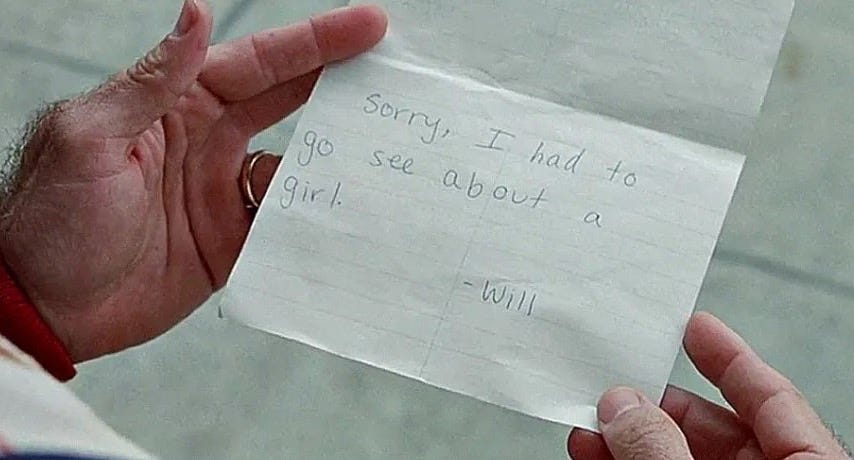
It is also what animates young Simba in The Lion King (1994) as he musically expresses his longing for freedom and autonomy in “I Just Can’t Wait to Be King.”
Speaking of waiting, the red is similarly responsible for a young Alexander Hamilton’s bashful response to a question about his identity in the 2015 musical that bears his name.
He believes that the answer to Angelica Schuyler’s question is “unimportant” because there are “a million things” he has yet to accomplish. “But just you wait,” he adds.
In the words of Martin Shaw, “someone in the red is not crippled with self-doubt but can act decisively in their ambition to get ahead.” Shaw continues:
Ambition is the key word here. It’s an individualistic position, not a community one. Not really. It’s about breaking from the pack and winning the race. It’s about working up a head full of steam and receiving the praise. The red likes an audience.
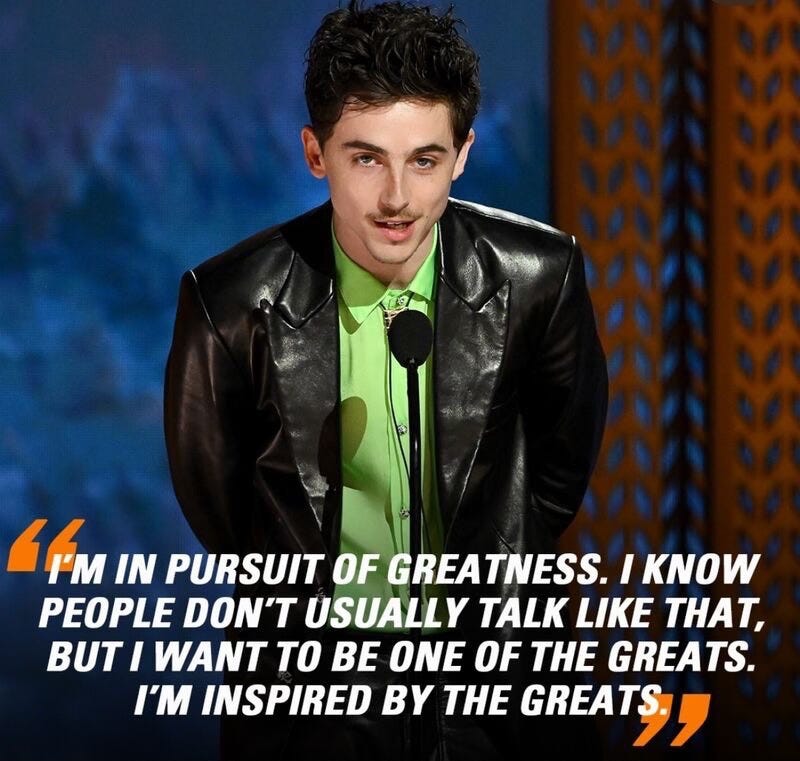
It almost goes without saying that the red can lead to catastrophe when left unchecked. However, it is also a fact that nothing great has ever come to fruition in this world without a healthy dose of the red setting hearts on fire for worthy causes. “Without the red,” remarks Shaw, “you will struggle to get the book finished, the move completed, the project launched.”
This tension is precisely what I had in mind when I told my pastor at a gathering of my church’s men last month that I desired to hold on to the positive aspects of my restless spirit whilst simultaneously letting go of the negative ones. Reluctant to attribute any virtue to my state of spiritual restlessness, he encouraged me to find a different word for the energy I was attempting to describe. After all, it had only been a matter of weeks since he had preached a sermon on rest from the book of Hebrews.
“So then, a Sabbath rest still remains for the people of God, for those who enter God’s rest also rest from their labors as God did from his. Let us therefore make every effort to enter that rest, so that no one may fall through such disobedience as theirs.” — Hebrews 4:9-11
I suspect that conversations such as this one will go a long way towards shaping my red drive for the best. To quote Shaw one last time:
Without mentoring, the red can create a warlike personality or community. With mentoring, someone in the red can really get things done for the good. They kick ass once they cop on to the notion of service.
In “Seeing Red (Pt. 2),” I will endeavour to share more of what my mentors — men and women whose histories are coloured with more than just one shade — have been teaching me about the red. I hope that their wisdom will bless you as much as it has blessed me.
Jacob and Wilhelm Grimm, “Der Eisenhans,” in Kinder und Hausmärchen (Children’s and Household Tales—Grimms’ Fairy Tales), vol. 2, no. 136 (Göttingen: Verlag der Dieterichschen Buchhandlung, 1857), 242–50.
Martin Shaw, Liturgies of the Wild: Myths That Make Us, narrated by Martin Shaw (Penguin Audio, 2026), audiobook.